|
|
 |
|
|
|
|
|
4.
Concessions
|
|
|
|
|
|
Children & Adolescents
|
|
We provide:
- Psycho-diagnostic
- Psycho-educational
- Neuropsychological
- Career-related
assessments for both children & adolescents.
We have an extensive Test
Library including tests that address a wide range of
psychological needs of children and adolescents.
|
|
|
 |
 |

|
| |
What is Psycho-Diagnostic Assessment with
Children & Adolescents?
 Our
psychologists administer: Our
psychologists administer:
- Psychometric tests (See our
Test Library for details)
- Questionnaires
- Interviews with the child or adolescent themselves
- Interviews with parents and family members where
relevant.
By conducting comprehensive psycho-diagnostic assessment, clear and effective
decisions can be made as to the best therapeutic and counselling direction to
overcome
the child or adolescent's specific challenges. To achieve this goal, we
administer:
- Standardized tests eg, (IQ) Intelligence, reading, mathematics,
etc. (See our Test Library for
details)
- Conduct interviews
- Use children's drawings, request teachers' reports, and so
on.
Once all information is gathered, through confidential discussion with the
family, the child or adolescent themselves, we interpret the psycho-diagnostic
findings.
Psycho-diagnosis properly conducted speeds up the process of healthy change
by clearly identifying the underlying needs for:
- Effective therapy
- Counselling
- Coaching
- And ensuring that treatment efforts are not unnecessarily
wasted.
When we conduct a psycho-diagnostic assessment we focus primarily on the
following aspects of effective psychological functioning:
- Emotional
- Social Skills
- Family Relations
- Peer Relations
- Personality
- Clinical (psychiatric)Disorders (where relevant)
|
|
 |
|

|
| |
What is Psycho-Educational Assessment with
Children & Adolescents?
Exam & Academic Concessions are a specialised component of
Psychoeducational Assessment and involve the preparation of official reports
for academic accommodations and exemptions of various kinds. As this is a
complex and specialised field, please click on this red box for further
information.
When assisting a child or adolescent adjust to educational challenges at school
or college, our psychologists follow the same methodology described above under
Psycho-Diagnostic Assessment, but focus especially on the
following areas of effective psychological functioning :
See our Test Library for details
- Intellectual Ability
- Scholastic Achievement - Reading, Writing, Mathematics, Oral
skills
- Concentration & Attention (ADHD & other related problems)
- Memory
- Sensorimotor Ability
- Visual-motor Skills
- Motor-Coordination
- Study Skills
- School Readiness
In a nutshell, a psycho-educational assessment attempts to identify:
- Correlations between a child or adolescent's natural abilities and
their relative academic performance; that is, the ability-achievement gap or
discrepancy.
- The extent and nature of the ability-achievement gap.
- Research-based recommendations to bridge this potential gap.
Initiatives involving:
- Remedial learning
- Study skills
- Psychotherapy
- Counselling
- Skills enhancement
- Life coaching
- School placement
- Occupational therapy
- Family and parent counselling
are examples of the many possibilities for creating positive change in order
for the child or adolescent to reach their full potential.
- Subject choice and later career applications are also
a core reason for psycho-educational assessment, and indeed often goes hand in
hand with career guidance for adolescents.
- School readiness is also a very useful procedure to ensure
that very young children get their best start to their educational future.
|
|
|
|
|
| |
What is Pediatric Clinical Neuropsychology?
 Pediatric clinical neuropsychology is
a specialist branch of psychology that focuses on the relationship between the
brain (neurological system) and the psychological functions of young people. Pediatric clinical neuropsychology is
a specialist branch of psychology that focuses on the relationship between the
brain (neurological system) and the psychological functions of young people.
It specifically considers the relationship of various brain or neurological
disorders and the child or adolescent's day to day psychological functioning;
that is,
- Behavioural
- Emotional
- Social
- Scholastic adjustment.
Pediatric neuropsychological problems might be caused by:
- Injury (eg, car accident, or fall),
- Illness (eg, rheumatic fever, cerebral palsy),
- Developmental trauma (eg, premature birth),
- Inherited (eg, primary ADHD)
- Substance induced (e.g TIK abuse)
Our pediatric neuropsychological assessments assess the following core
domains of functioning using specialized psychometric testing
instruments:
See our Test Library for details
- General (IQ) Intelligence
- Language
- Executive functioning/attention/concentration
- Sensorimotor
- Memory & learning
- Visual-spatial
(See our Test Library for details)
After careful neuropsychological assessment, findings are consolidated with
any psycho-diagnostic or psycho-educational considerations. Recommendations for
therapeutic management are generated, and may include:
- Psychotherapy
- Remediation
- Physiotherapy
- Occupational therapy
- Learning assistance
- Family or parent counselling
Please also refer to our medico-legal reports page
for further information on clinical neuropsychology.
|
|
|
|
|
|
| |
What does Career Assessment for Adolescents
involve?
 Career Assessment is useful for
adolescents from the early teens onwards, especially when making career
decisions involving: Career Assessment is useful for
adolescents from the early teens onwards, especially when making career
decisions involving:
- Tertiary level training at university
- College
- Apprenticeships, and so on.
Subject choices in early high school or even late primary school are often
crucial in deciding their future career paths. To assist young people in
making their best decision regarding future career success, study direction
and subject choices, our psychologists use:
During our career assessments the following core areas are focused on:
- Aptitude and (IQ) Intelligence
- Interests
- Personality
- Values
- Emotional predispositions
- Social orientation
- Emotional (EQ) Intelligence
- Motivation
Once a career assessment is completed and the findings shared with the client
and their family or other significant people in their world, a career
development plan is typically generated. Should:
problems present during the career assessment, their remedy can be built into
the career development plan. Mostly, however, study and institution options
are considered and career counselling provided where confusion or uncertainty
exists to ensure optimal decision-making regarding the individual adolescent's
chosen career path.
|
|
|
|
|
| |

|
|
Adults
|
|
We do comprehensive:
- Psycho-diagnostic assessment
- Neuropsychological assessments
- Career guidance
- Vocational assessment
- Psycho-educational
We also provide adult psycho-educational assessments when academic
pursuits and studying are important challenges. We have an extensive Test Library including tests that address
all possible psychological needs of adults.
|
|
|
|
|
|
| |
How does Psycho-Diagnostic assessment
work with Adults?
 To better understand the emotional and social
adjustment of the individual adult seeking assistance, our psychologists
administer: To better understand the emotional and social
adjustment of the individual adult seeking assistance, our psychologists
administer:
By conducting comprehensive psycho-diagnostic assessment, clear and effective
decisions can be made as to best therapeutic and counselling direction to
overcome the client's specific challenges. To achieve this goal, we administer
standardised tests (e.g. Emotional functioning, personality and conduct
interviews.)
Once all information is gathered, through confidential discussion with the
client and other significant people where necessary, we interpret the
psycho-diagnostic findings.
Psycho-diagnosis properly conducted speeds up the process of healthy change
by clearly identifying the underlying needs for:
- Effective therapy
- Counselling
- Coaching
- And ensuring that treatment efforts are not unnecessarily wasted.
When we conduct a psycho-diagnostic assessment we focus primarily on the
following aspects of effective psychological functioning:
- Emotional
- Social Skills
- Family Relations
- Peer Relations
- Personality
- Clinical (psychiatric) Disorders
|
|
|
|
|
| |
What is Adult Clinical Neuropsychology
assessment?
 Clinical neuropsychology is a
specialist branch of psychology that focuses on the relationship between the
brain (neurological system) and the psychological functions of adults. It
specifically considers the relationship of various brain or neurological
disorders and the adult's day to day psychological functioning; that is,
their: Clinical neuropsychology is a
specialist branch of psychology that focuses on the relationship between the
brain (neurological system) and the psychological functions of adults. It
specifically considers the relationship of various brain or neurological
disorders and the adult's day to day psychological functioning; that is,
their:
- Behavioural
- Emotional
- Social
- Occupational adjustment
Adult clinical neuropsychological problems might be caused by:
- Injury (eg, car accident, or fall)
- Illness (eg, Alzheimers, stroke)
- Developmental trauma (eg, premature birth)
- Inherited (eg, primary ADHD)
- Substance induced (e.g TIK abuse)
- Neuro-psychiatric disorders (e.g. bipolar,
schizophrenia)
Our neuropsychological assessments assess the following core domains of
functioning using specialized psychometric testing instruments (see to our Test Library for details):
- General (IQ) Intelligence
- Language
- Executive functioning/attention
- Sensorimotor
- Memory & learning
- Visual-spatial
After careful neuropsychological assessment, findings are consolidated with
any psycho-diagnostic or psycho-educational considerations. Recommendations
for therapeutic management are generated, and may include:
- Psychotherapy
- Remediation
- Physiotherapy
- Occupational therapy
- Learning assistance
- Family counselling, and so on.
Please also refer to our medico-legal reports page
of our website for further information on adult clinical
neuropsychology.
|
|
|
|
|
| |
When is Adult Psycho-Educational
assessment useful?
Exam & Academic Concessions are a specialised component of
Psychoeducational Assessment and involve the preparation of official reports
for academic accommodations and exemptions of various kinds. As this is a
complex and specialised field, please click on this red box for further
information.
 When assisting a person to adjust to
educational challenges at universities or colleges for further education, our
psychologists follow the same methodology described as above under Psycho-Diagnostic assessment for Adults but focus
especially on the following areas of effective psychological functioning: When assisting a person to adjust to
educational challenges at universities or colleges for further education, our
psychologists follow the same methodology described as above under Psycho-Diagnostic assessment for Adults but focus
especially on the following areas of effective psychological functioning:
See our Test Library for details
- Intellectual Ability
- Scholastic Achievement - Reading, Writing, Mathematics, Oral
skills
- Concentration & Attention (ADHD & other related problems)
- Memory
- Sensorimotor Ability
- Visual-motor Skills
- Motor-Coordination
- Study Skills
in a nutshell, a psycho-educational assessment with adults attempts to
identify:
- Correlations between an individuals natural abilities and their
relative academic achievements and performance; that is, the
ability-achievement gap or discrepancy.
- The extent and nature of the ability-achievement gap.
- Research-based recommendations to bridge this potential gap.
Initiatives involving:
- Remedial learning
- Study skills
- Psychotherapy
- Counselling
- Skills enhancement
- Life coaching
- Educational placement
- Occupational therapy
- Family and parent counselling
are examples of the many possibilities for creating positive change in order
for the individual adult to reach their full potential.
Further study options may be considered together with optimizing career
planning and growth given the individual's previous experience, training, and
educational background. Psycho-Educational initiatives are often usefully
combined with "Career and Vocational Assessment".
|
|
|
|
|
| |
What happens during Career and Vocational
assessment?
 Career assessment is useful for adults
when: Career assessment is useful for adults
when:
- Reviewing their past, present and future career paths
- Making career transitions
- Reformulating career goals
- Reviewing personal strengths and weaknesses for optimal career
success
- Identifying the relative fit of the individual with specific work
roles
- Enhancing optimal career success for further career coaching
initiatives
- Identifying possible further study options for career success and
this can be combined with
Psycho-Educational initiatives
To assist people in making their best decision regarding future career
success, our psychologists use:
- Interviews
- Questionnaires
- Psychometric tests (See our
Test Library for details)
- Active dialogue with the clients and other significant people in
their lives as necessary.
During our career assessments the following core areas are focused on:
- Aptitude and (IQ) Intelligence
- Interests
- Personality
- Values
- Emotional predispositions
- Social orientation
- Emotional (EQ) Intelligence
- Motivation
Once a career assessment is completed and the findings shared with the client
and other significant people in their world as required, a career development
plan is generated. Should psycho-diagnostic, psycho-educational or neuropsychological problems present during the career
assessment, their remedy can be built into the career development plan.
Mostly, however career focussed counselling is provided to ensure optimal
decision-making regarding the client's chosen career or vocational path
success.
|
|
|
 |
|
| |

|
|
Elderly
|
|
Elderly people may require psycho-diagnostic and/or
neuropsychological assessment as many age-related
disorders can cause cognitive impairment and other forms of psychological
dysfunction. These problems may affect the elderly person's competence in
a wide range of everyday activities. See to our
Test Library for details . At our practice we can assess the
psychological functioning of the elderly, by providing an individual
profile for each person. We then offer the necessary counselling and
guidance to the elderly person themselves, as well as to their family
members and other caregivers, as is useful in each case.
A typical assessment with the elderly would include the battery of tests
described under the adult assessment section above, but
adjusted for concerns pertaining to specific needs of the elderly person.
We have an extensive Test Library including
tests that address all possible psychological needs of adults.
|
|
|
|
|
|
|
|
| |
Concessions
What are Exam
Concessions?
An exam concession, also
known as an
accommodation or special
arrangement, is a
formally granted
adjustment to the
standard way a test or
examination is taken.
Its single, vital
purpose is to create a
level playing field. It
is not about giving a
candidate an unfair
advantage; it is about
removing the specific
barriers that prevent a
capable individual from
accurately demonstrating
their knowledge, skills,
and potential under
standard timed or
written conditions.
In South Africa, these
concessions are governed
by specific policies set
by the Department of
Basic Education (DBE),
Independent Examinations
Board (IEB), and
tertiary institutions.
The process is built on
the principle of
fairness: a learner’s
underlying cognitive or
processing challenge
should not be the thing
that is measured. An
exam concession is the
bridge between a real,
documented barrier and a
fair opportunity for
success.
This journey always
begins with a
comprehensive
psycho-educational or
neuropsychological
assessment by a
qualified psychologist.
The goal is to identify
why a seemingly capable
child, adolescent, or
adult underperforms in
exams and to provide the
empirical evidence
needed to recommend the
right support.
|
|
|
|
|
| |
Why are
they Needed?
 Exam conditions
are
inherently demanding. They
test not just knowledge, but also a cluster of
underlying skills: sustained attention,
processing speed, working memory, reading
fluency, spelling, and fine motor coordination
for handwriting. For an individual with a
condition like ADHD, Dyslexia, or an anxiety
disorder, a standard exam doesn’t just measure
subject knowledge – it primarily measures the
impact of their difficulty. Common reasons for
referral include: Exam conditions
are
inherently demanding. They
test not just knowledge, but also a cluster of
underlying skills: sustained attention,
processing speed, working memory, reading
fluency, spelling, and fine motor coordination
for handwriting. For an individual with a
condition like ADHD, Dyslexia, or an anxiety
disorder, a standard exam doesn’t just measure
subject knowledge – it primarily measures the
impact of their difficulty. Common reasons for
referral include:
- A bright child who cannot complete papers
within the time limit.
- A student whose anxiety causes their mind to
“go blank,” dramatically impairing recall.
- A learner who understands complex concepts
but produces work with illegible handwriting
or spelling errors that a teacher cannot
follow.
- An adult pursuing a new degree or
professional qualification who realises for
the first time that an old, unaddressed
learning difficulty is now a significant
hurdle.
|
|
|
|
|
| |
What are
the Different Types of Concession?
 The specific
concession granted is always matched
to the individual’s documented needs. They are
not a one-size-fits-all promise, but a tailored
set of recommendations from the psychologist’s
report. Common accommodations include: The specific
concession granted is always matched
to the individual’s documented needs. They are
not a one-size-fits-all promise, but a tailored
set of recommendations from the psychologist’s
report. Common accommodations include:
- Extra Time: The most frequent concession, often essential
for learners with slow processing speed, reading difficulties like dyslexia,
or attention regulation challenges like ADHD.
- Scribe: A scribe writes down exactly what the candidate
dictates, word-for-word, managing spelling and handwriting. This is vital
for those with a specific learning disorder in written expression
(dysgraphia) or a motor coordination challenge.
- Reader: A reader reads the entire question paper aloud to
the candidate, crucial for learners with severe reading difficulties
(dyslexia), where decoding text itself is a barrier.
- Use of a Computer:
Allows a candidate to type answers, using spell-check and bypassing
handwriting demands. This is a common modern accommodation for high school
and tertiary students.
- Rest Breaks: Permits a candidate to stop the clock for
short, supervised breaks to manage fatigue, maintain focus, or regulate high
anxiety.
- Separate or Small-Group Venue:
Reduces sensory overload and distraction, particularly helpful for
individuals with ADHD, autism spectrum characteristics, or significant test
anxiety.
- Prompter: A trained adult discreetly refocuses a
candidate who has become distracted, often used for students with ADHD.
- Braille, Large Print, or Enlarged
Print:
For candidates with visual impairments.
- Alternative Examination Formats
(Oral/Practical): For candidates with visual impairments.
- Communication Concession (South
African Sign Language):
Specifically for deaf candidates.
|
|
|
|
|
| |
How our Assessment
Process
Works
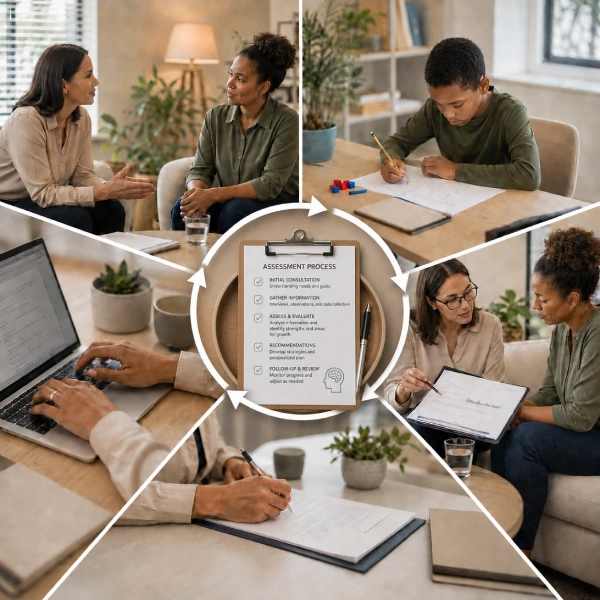 A successful
application for any of
these concessions requires a thorough, valid
justification. Our process is aligned with the
stringent requirements of education departments
and boards, and it entails: A successful
application for any of
these concessions requires a thorough, valid
justification. Our process is aligned with the
stringent requirements of education departments
and boards, and it entails:
- Initial Consultation: We
meet with the parents or the adult candidate
to understand the full developmental,
educational, and medical history, and to
clarify the specific exam-taking
difficulties being observed.
- Comprehensive Assessment:
We
conduct a tailored battery of standardised,
clinically proven psychometric tests to
objectively measure cognitive ability (IQ),
memory, processing speed, phonological
processing, reading, spelling, writing, and
academic fluency. Crucially, we also screen
for emotional factors like test anxiety,
which are equally important.
- Integration and
Feedback: Our analysis compares
ability with achievement. A significant
discrepancy – for example, a very high
verbal intellect alongside very low
processing speed – provides evidence for a
concession like extra time. A feedback
session is scheduled in which we explain
these results, provide a clear diagnosis (if
applicable), and offer actionable
recommendations.
- Professional Report:
The results are presented in a detailed,
professional psychological report ready for
submission to schools or
examination/evaluation boards that outlines
the key findings and clear, practical
recommendations.
- Completion of Official
Documentation:
Our psychologists are experienced
in completing the official application forms
required by the relevant education
department, various universities, or adult
evaluation environments to facilitate a
successful concession application.
|
|
|
|
|
| |
Concessions Across the Lifespan:
Children, Teenagers, Matriculants, Students, and Adults
 The particular challenge and nature of the
assessment shifts
across different
life stages, but the core principle of fairness remains constant: The particular challenge and nature of the
assessment shifts
across different
life stages, but the core principle of fairness remains constant:
- Children & Pre-Teens: The focus here is often on early
identification for formal school assessments. We work to establish sound
work habits early, reducing academic anxiety and preventing a cycle of
failure before high school.
- Teens & Matriculants: This is the most critical juncture.
The pressure is immense. Our robust, DBE/IEB-focused assessments are
designed to secure the vital concessions needed for mid-year and final
National Senior Certificate (NSC) exams.
- University & College Student: Many previously undiagnosed
learning or attentional issues emerge under the independent demands of
tertiary study. We provide detailed reports so students can access time
accommodations, lecture notes, or separate venues, helping them complete
their degrees.
- Adults: An individual returning to study, or sitting
professional board exams, can apply for accommodations based on a
long-standing or newly diagnosed condition. We can provide the necessary
documentation to petition these examining bodies on the principle of
equitable opportunity.
Our goal is to guide each individual through this process with clarity and
compassion, ensuring that the outcome is a true reflection of their ability,
not their barrier.
Contact us to find out more about how a Concession Assessment could help your
child, teen, young adult, or adult learner thrive academically!
|
|
 |
|
|
|
|
|


.jpg)